Hierarchy: From Cluster to the REDAC
This page explains the structural hierarchy of the REDAC hardware, starting with the computation cluster and moving upward to the complete REDAC rack. It is a hardware-structure overview. The lower-level pages describe the detailed behavior of the individual blocks.
Hierarchy Overview
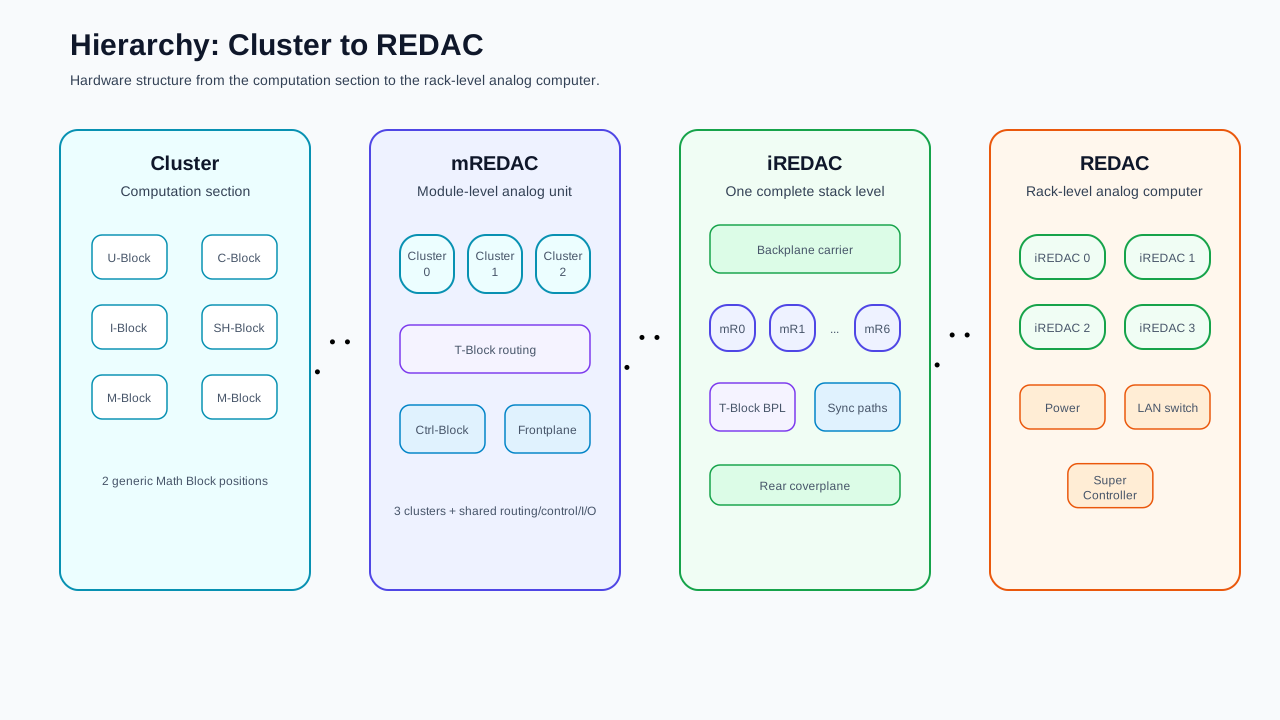
The REDAC hierarchy is built from repeated analog-computation structures:
- A cluster is the local computation section inside an mREDAC.
- An mREDAC combines three clusters with shared module-level routing, control, and front I/O.
- An iREDAC combines up to seven mREDACs on one backplane and exposes rear coverplane interfaces.
- A REDAC combines multiple iREDAC stack levels with rack-level power, networking and control.
Cluster
A cluster is the computation section of an mREDAC. It contains the common signal-preparation path and two generic Math Block positions.
Each cluster contains:
- 1 U-Block for source selection and forwarding into the cluster path.
- 1 C-Block for coefficient, weighting, and sign behavior.
- 1 I-Block for summing selected contributions into cluster channels.
- 1 SH-Block for sample/hold, compensation, injection, and passthrough-oriented behavior.
- 2 M-Block positions for Math Block DIMMs.
The M-Block positions are generic at hierarchy level. The installed M-Block type determines the mathematical function available at that position.
mREDAC
An mREDAC is the module-holder level analog computing unit. It combines three clusters with shared routing, control, and external/front-side interface resources.
Each mREDAC contains:
- 3 clusters.
- 1 T-Block for mREDAC-level routed-lane interconnection.
- 1 Ctrl-Block for configuration, supervision, measurement-oriented access, and coordination.
- A frontplane interface for module-level external I/O and system connections.
The clusters provide the computation resources. The T-Block provides module-level routing for the routed lane range. The Ctrl-Block provides the control and supervision side of the module.
The U-Block, C-Block, I-Block, SH-Block, M-Blocks, T-Block, and Ctrl-Block are implemented as DIMM-format plug-in modules installed in the mREDAC module holder/carrier.
iREDAC
An iREDAC is one complete REDAC stack level. It combines the carrier/interconnect backplane, installed mREDAC modules, front-side access through the mREDAC frontplanes, and rear external access through the coverplane.
Each iREDAC contains:
- 1 iREDAC backplane.
- Up to 7 mREDAC modules in backplane slots
0..6. - Frontplane access on the installed mREDACs.
- Backplane-level T-Block BPL routing resources.
- Synchronization paths for coordinating mREDACs within the iREDAC and, when configured, adjacent iREDACs.
- 1 rear coverplane for external analog, synchronization, power, USB, and Ethernet/LAN access.
The backplane is the carrier and interconnect board of the iREDAC. It holds the mREDACs, routes supported topology lanes between mREDAC slots and adjacent iREDAC paths, and distributes the control, synchronization, and network paths needed at iREDAC level.
REDAC
A REDAC is the rack-level analog computer. It stacks multiple iREDAC levels in one rack and adds the rack-level infrastructure needed to operate them as one larger analog computing system.
The current REDAC rack contains:
- 4 populated iREDAC stack levels, numbered
0..3. - Rack-level power supply.
- LAN switch for controller communication.
- Super controller for rack-level configuration and coordination.
- Reserved expansion/service space that can support a five-iREDAC configuration when populated accordingly.
Each iREDAC provides up to seven mREDAC positions. A fully populated four-iREDAC REDAC therefore provides up to 28 mREDAC module positions. A five-iREDAC configuration provides up to 35 mREDAC module positions.
One or more additional REDAC racks can also be connected as a larger system option when more resources are needed.
Structural Summary
| Level | Contains | Role |
|---|---|---|
| Cluster | U-Block, C-Block, I-Block, SH-Block, 2 M-Block positions | Local analog computation section. |
| mREDAC | 3 clusters, T-Block, Ctrl-Block, frontplane interface | Module-level computation, routing, control, and front I/O. |
| iREDAC | Backplane, up to 7 mREDACs, T-Block BPL resources, sync paths, coverplane | One complete REDAC stack level. |
| REDAC | Multiple iREDACs, power, LAN switch, super controller | Rack-level analog computer. |