Frontplane
The frontplane is the front-side external I/O interface of an mREDAC. It provides four AUX connectors for module-level signal access. Each AUX connector can be used as an analog front I/O signal, and each connector also has a fixed digital function when configured for digital use.
The frontplane is associated with Cluster 0 lanes 28..31. These associations provide four dedicated front I/O endpoints for the mREDAC.
Architecture Overview
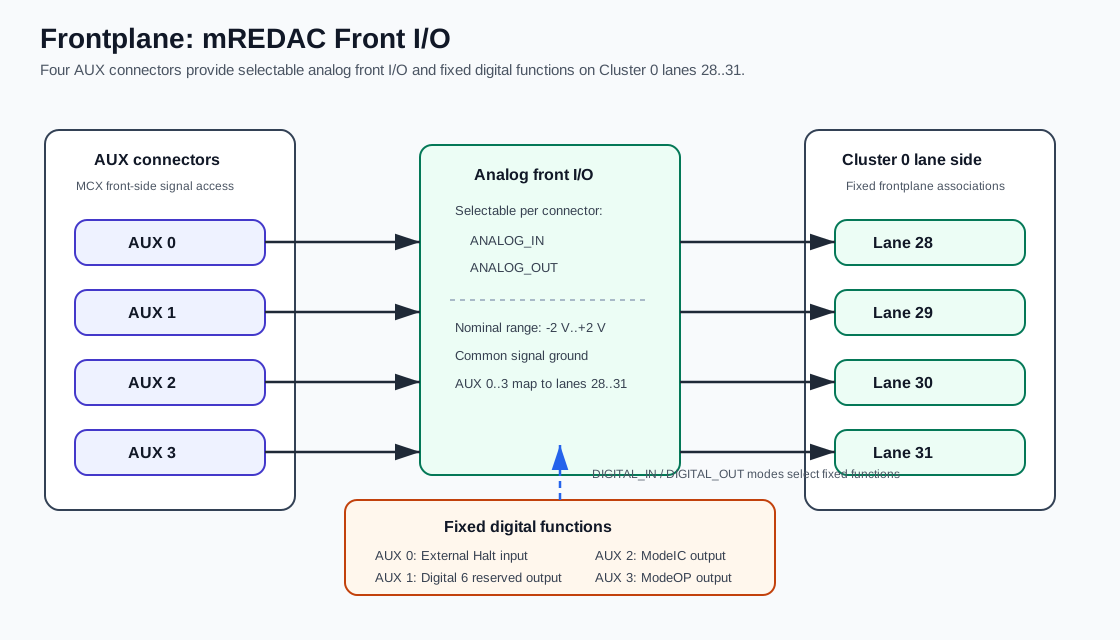
The diagram shows the four AUX connectors, their fixed lane associations on Cluster 0, their selectable analog I/O mode, and their fixed digital functions.
Role in the mREDAC
The frontplane provides direct front-panel access to selected mREDAC signals. It is useful when a setup needs external analog signal input, analog signal output, or one of the fixed digital control/status functions available on the AUX connectors.
The four AUX ports are tied to the high end of the Cluster 0 lane range:
| AUX connector | Cluster 0 lane association |
|---|---|
| AUX 0 | 28 |
| AUX 1 | 29 |
| AUX 2 | 30 |
| AUX 3 | 31 |
At architecture level, treat these as front I/O endpoints associated with those lanes. Local cluster configuration and frontplane mode selection determine how they are used in a concrete setup.
Connector Type
- Connector type: MCX micro coaxial connector according to IEC 61169-36.
- Part: Rosenberger 29K102-400L5 jack/socket.
- Impedance: 50 ohm.
- Frequency range: DC to 6 GHz.
- Signal contact: center pin.
- Ground reference: connector outer contact and common signal ground.
Analog Signal Use
- AUX
0..3can be configured as analog front I/O signals. - Analog signals are bipolar and use the common ground reference.
- Nominal analog range is
-2 V..+2 V(4 Vpp). - Absolute maximum input rating is
+/-5 V. - The analog-capable paths are associated with Cluster 0 signal lanes
28..31.
Digital Signal Use
Digital use follows fixed function and direction assignments. The pybrid mode selects whether each AUX connector uses its analog mode or its assigned digital function.
| Port | Analog lane association | Digital function |
|---|---|---|
| AUX 0 | Cluster 0 lane 28 |
External Halt input |
| AUX 1 | Cluster 0 lane 29 |
Digital 6 reserved output |
| AUX 2 | Cluster 0 lane 30 |
ModeIC output |
| AUX 3 | Cluster 0 lane 31 |
ModeOP output |
Digital output level is LVTTL-style 0 V / 3.3 V. Digital input level is TTL-compatible 0 V / 5.0 V. Respect the same absolute maximum rating for externally applied input signals.
Programming with pybrid
In pybrid, the mREDAC frontplane mode selection is represented on the carrier by front_panel_io. The list has four entries, one for each AUX connector in AUX 0..3 order:
from pybrid.redac.carrier import FrontPanelIOMode

carrier.front_panel_io = [
    FrontPanelIOMode.ANALOG_IN,
    FrontPanelIOMode.ANALOG_OUT,
    FrontPanelIOMode.ANALOG_IN,
    FrontPanelIOMode.ANALOG_OUT,
]
The four entries correspond to AUX 0..3 and to Cluster 0 lane associations 28, 29, 30, and 31.
The enum values are:
FrontPanelIOMode.ANALOG_OUT  # 0
FrontPanelIOMode.ANALOG_IN   # 1
FrontPanelIOMode.DIGITAL_OUT # 2
FrontPanelIOMode.DIGITAL_IN  # 3
Use ANALOG_IN or ANALOG_OUT for analog operation. Use DIGITAL_IN or DIGITAL_OUT only according to the fixed digital functions listed above.
For configuration that should be applied to real hardware, update the discovered carrier model and send the resulting REDAC configuration through a session:
from pybrid.redac import Controller
from pybrid.redac.carrier import FrontPanelIOMode

async with Controller() as controller:
    await controller.add_device("192.168.1.10", 5732)

    carrier = controller.computer.carriers[0]
    carrier.front_panel_io = [
        FrontPanelIOMode.ANALOG_IN,
        FrontPanelIOMode.ANALOG_OUT,
        FrontPanelIOMode.DIGITAL_OUT,
        FrontPanelIOMode.DIGITAL_OUT,
    ]

    await controller.create_session().set_config(controller.computer).execute()
The example uses the first discovered carrier as a placeholder for the selected mREDAC. In a multi-carrier REDAC setup, select the carrier that corresponds to the intended mREDAC slot. front_panel_io configures the operating mode of the four dedicated AUX endpoints.